
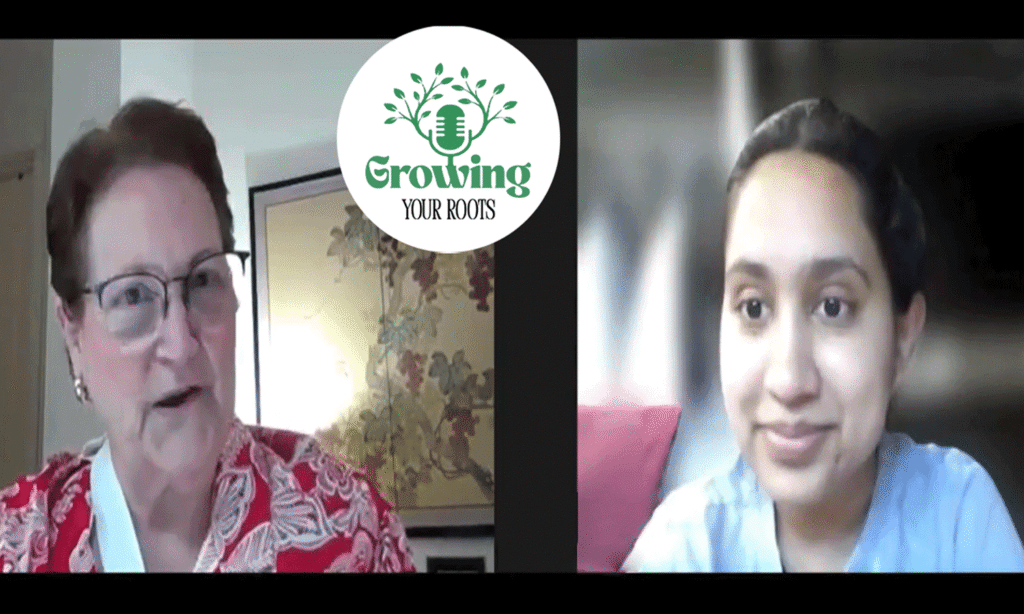
From challenging gender inequality as a young athlete to expanding educational opportunities across the world, Ms. Margit Moore reflects on the values that shaped her life and why the next generation gives her hope.
What does it mean to truly live by your values?
We often describe our values through words like kindness, curiosity, generosity, and fairness. But how often do we stop to consider where those values come from, how they shape our decisions, and whether our actions genuinely reflect them?
In this episode of Rooted Voices, I had the opportunity to speak with Ms. Margit Moore, a mother, educator, feminist, activist, and mentor who has spent much of her life in the Seattle area. Drawing on her Native American and white heritage, her family’s history, and decades of advocacy, Ms. Moore shared how curiosity, courage, and generosity have guided her efforts to create meaningful change.
Her stories took us from family photographs and childhood memories to gender equality in sports, international education, and the importance of empowering young people.
Throughout our conversation, one message stood out: Values are not meant to be admired from a distance. They are meant to be lived.
Discovering Family Values Through Generations of Stories
After her mother’s passing, Ms. Moore spent approximately four years sorting through belongings preserved by several generations of her family.
Among the collections were marriage certificates, graduation records, photographs, letters, newspaper clippings, patents, travel documents, and even her grandfather’s pilot’s license.
What initially appeared to be an overwhelming collection of family possessions gradually became an opportunity to understand her family’s history.
She recalled spending hours examining boxes of memorabilia. Her roommate would leave for the evening and return six hours later, surprised to find her still working through the same materials.
Although her roommate suggested simply having the belongings hauled away, Ms. Moore couldn’t imagine doing so.
For her, preserving and understanding those objects was a way of honoring the people who came before her.
Through this process, she began identifying the values that had persisted across generations: intellectual and cultural curiosity, a willingness to take risks, generosity, and gratitude.
These were not merely characteristics her family spoke about. They were principles reflected in the decisions they made and the lives they lived.
As Ms. Moore explained, values should not be “kept under glass.”
Instead, they should guide our daily actions, shaping the legacy we leave behind.
Challenging Inequality: A Young Girl Who Refused to Accept No
One of the most striking stories Ms. Moore shared began during her junior high school years in Bellevue, Washington, in the early 1970s.
At the time, girls had few opportunities to participate in organized school athletics.
Ms. Moore and several other students wanted to establish a girls’ soccer team. However, school administrators told them there was no funding, equipment, field, or coach available.
Rather than accepting the decision, Ms. Moore decided to try out for the boys’ baseball team.
What followed was an experience that required extraordinary determination.
Throughout the week of tryouts, she faced public opposition, harassment, and ridicule. Protesters appeared with signs, newspapers covered the controversy, and students continued to heckle her at school.
She even recalled people throwing bottles from passing cars as she walked home.
Despite being a capable athlete, she was ultimately denied a place on the team.
Yet her efforts were not entirely unsuccessful.
The following year, the school offered a girls’ soccer team.
Although Ms. Moore did not personally gain a position on the boys’ baseball team, her willingness to challenge the rules helped demonstrate the need for equal athletic opportunities.
Her experience took place before the passage of Title IX, the landmark federal legislation that would later expand protections against sex discrimination in education.
Reflecting on the experience, Ms. Moore emphasized that meaningful change often requires courage and sacrifice.
Not every effort produces an immediate victory. Sometimes, the impact becomes visible only after someone has taken the first difficult step.
Her story reminded me that progress is rarely inevitable. Behind many of the opportunities we take for granted today are people who challenged what others considered normal.
A Family Tradition of Courage and Curiosity
Ms. Moore credits much of her willingness to challenge established expectations to her mother.
Having attended the High School of Music & Art in New York City before moving to suburban Bellevue in the 1950s, her mother brought a perspective shaped by different communities and experiences.
Rather than discouraging Ms. Moore from taking risks, she encouraged her to pursue what she believed was right.
That spirit of exploration extended further back through her family history.
Ms. Moore recalled discovering photographs of her grandfather growing up on a farm in Illinois.
At eighteen, he left the farm to become an airplane mechanic during a period when aviation was still relatively unfamiliar to many Americans.
He eventually became a professional pilot and later served as a military pilot.
For Ms. Moore, his journey represented more than an adventurous career choice. It demonstrated the importance of curiosity and the courage to pursue unfamiliar opportunities.
She recognized similar qualities in her own children, whose work has included international education and sustainable agriculture in African countries.
Across generations, the details of their lives have changed, but their willingness to explore the world and contribute to it has remained.
From Personal Values to Community Advocacy
Ms. Moore’s commitment to fairness did not end with her childhood experiences.
At sixteen, she became involved in leadership with the American Civil Liberties Union (ACLU) in the Eastside area.
Her interest in constitutional law eventually led her toward studying society and justice, combining elements of social work and criminology.
Later, she transitioned into education, a field she believed could create lasting opportunities for individuals and communities.
Throughout her career, Ms. Moore has worked on initiatives serving students with different educational needs.
She described helping establish a high school gifted program in the Bellevue School District, teaching remedial reading, and supporting students who would become the first in their families to attend college.
Her advocacy has also included work involving Native American education, women-owned businesses, and political representation.
Among her efforts, she discussed supporting a Native American magnet school in Seattle and helping establish a women of color in politics organization involved in endorsements across Washington State.
She also spoke about the personal consequences of challenging organizations she believed were failing to uphold their commitments to diversity and inclusion.
For Ms. Moore, the principle remains consistent: if fairness and inclusivity are important, they must be reflected in how institutions operate, not simply in the language they use.
Education as a Pathway to Choice
One of the most moving parts of our conversation centered on Ms. Moore’s involvement in educational initiatives abroad.
Her work has extended beyond Washington State to communities in Mongolia, Senegal, and Timor-Leste.
She spoke particularly about a scholarship initiative in Timor-Leste that began when her son was serving in the Peace Corps in 2004.
In the community they supported, even modest school fees could place education beyond the financial reach of many families, particularly girls.
Through scholarships and continued support, students gained opportunities to pursue education that might otherwise have been inaccessible.
At the time of our interview, Ms. Moore explained that the initiative had reached a second generation of scholarship recipients. Some students were even pursuing graduate education.
Her family was also exploring the possibility of purchasing a house in Dili to provide accommodation for students continuing their studies.
Initially, I reflected on how powerful it was that these educational opportunities could help students pursue futures beyond the limitations of their circumstances.
But Ms. Moore offered an important clarification.
“The idea is that you’ve got choices.”
She explained that education does not mean everyone must follow the same path.
A student might attend high school and later choose to return to their family’s agricultural work. Another might pursue university or graduate school.
Neither path is inherently more valuable.
What matters is that individuals have the freedom and opportunity to decide for themselves.
Her response shifted the focus of our conversation from education as a particular destination to education as a means of expanding human possibility.
The Next Generation of Leaders Around a Dinner Table
Ms. Moore shared another memorable story about a family gathering attended by scholarship recipients from Timor-Leste who were studying in the United States.
During dinner, her son looked around the table and recognized the extraordinary potential of the young people gathered there.
Some were preparing for careers in medicine, others in civil engineering, and still others in journalism.
Together, they represented a future generation of professionals who could return home and contribute to their country’s development.
It was a powerful moment, not because of an elaborate ceremony or public recognition, but because it occurred during an ordinary family meal.
For Ms. Moore, the gathering demonstrated how meaningful change can emerge through small, practical actions.
Offering a meal, providing a scholarship, sharing knowledge, or connecting people with opportunities may seem modest in isolation.
But these actions can contribute to something much larger.
The dinner table became a symbol of what can happen when generosity is transformed into opportunity and opportunity into leadership.
Why Ms. Moore Believes in Young People
Toward the end of our conversation, I asked Ms. Moore what values she hoped future generations would carry forward.
Her response surprised me.
Rather than focusing on what young people needed to improve, she emphasized what they were already doing well.
As a former middle school and high school educator, she expressed admiration for the openness and acceptance she had observed among younger generations.
She described young people as increasingly willing to engage with different backgrounds, perspectives, and experiences.
While acknowledging that her observations came from the students and communities she knew, she expressed genuine optimism about their ability to lead.
In fact, Ms. Moore suggested that older generations should recognize when it is time to step aside and support emerging leaders.
Instead of controlling the direction of change, experienced adults can provide mentorship, encouragement, and resources.
They can create space for younger people to take initiative.
Her message was especially meaningful because discussions about younger generations often focus on their perceived shortcomings.
Ms. Moore offered a different perspective: young people already possess many of the qualities necessary to build a more inclusive and thoughtful future.
What they need is the opportunity to put those qualities into action.
Living Your Values, Not Just Believing in Them
Throughout our conversation, Ms. Moore returned to a lesson passed down by her mother: we have a responsibility to make the world better.
It was a direct expectation, one that shaped how she understood her role in her family, community, and society.
From challenging unequal opportunities in school athletics to supporting educational programs around the world, Ms. Moore’s experiences illustrate how a single set of values can influence many different decisions over a lifetime.
Her commitment to curiosity encouraged her to learn about unfamiliar cultures and perspectives.
Her belief in fairness motivated her to challenge exclusion.
Her generosity inspired efforts to expand opportunities for others.
And her willingness to take risks helped transform those beliefs into tangible action.
What stayed with me most was not simply the number of initiatives Ms. Moore had undertaken, but the consistency connecting them.
Whether she was a young student challenging school administrators or an educator supporting international scholarships, her actions reflected the same fundamental principles.
Perhaps the most meaningful way to honor the values we inherit is not merely to preserve them, but to practice them.
Through Ms. Moore’s stories, I was reminded that our roots are not limited to our ancestry or the traditions we remember. They also include the lessons we inherit, the choices we make, and the ways we influence the people around us.
And as those values pass from one generation to the next, they have the potential to create change far beyond the families in which they began.
That is what Rooted Voices seeks to explore: how personal stories reveal the beliefs, experiences, and relationships that shape who we are, and how understanding those stories can inspire us to shape the world around us.
This article is based on a Rooted Voices interview with Ms. Margit Moore, exploring family values, courage, educational opportunity, community advocacy, and intergenerational change.