
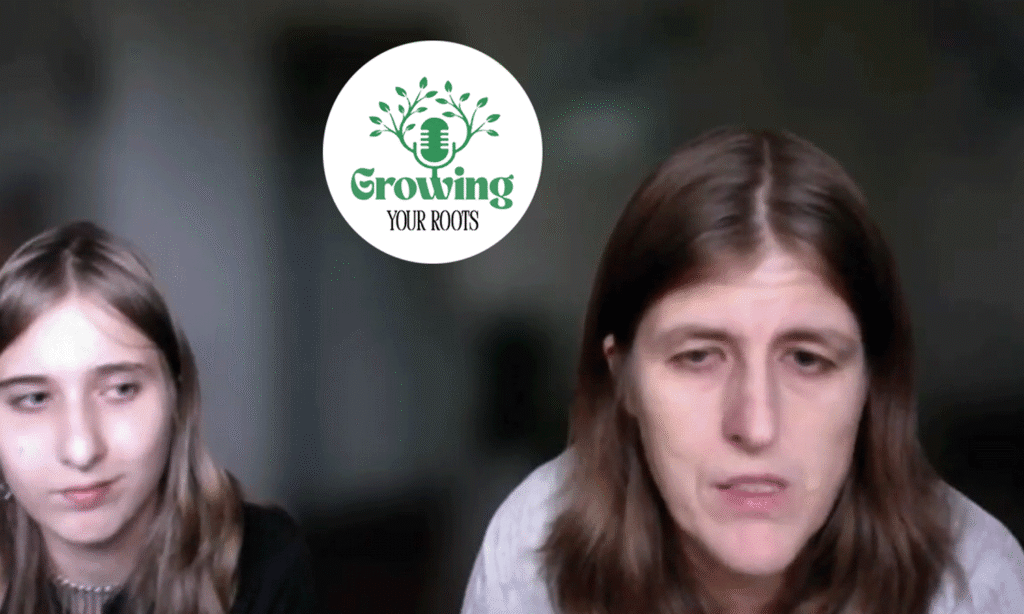
What does it mean to stay connected to your roots while building a life somewhere new? Through stories of immigration, family traditions, and personal identity, Elena and Olga explore how our past continues to shape who we become.
For many immigrant families, culture is more than a collection of traditions. It lives in the languages spoken at home, the food shared around the dinner table, the holidays celebrated together, and the stories passed down through generations.
In this episode of Growing Your Roots, I had the opportunity to speak with Elena and Olga, two family members whose experiences offer different perspectives on Russian and Ukrainian heritage. From Elena’s childhood in Moscow to Olga’s reflections on navigating a multicultural identity, their stories reveal both the challenges and the beauty of staying connected to one’s roots.
A Childhood in Moscow: Remembering a Different Way of Life
Growing up in Moscow, Elena remembers a childhood filled with music, community, and opportunities that were accessible to her family.
Raised by a single mother, she describes a comfortable, modest upbringing in which public services played an important role. Healthcare and education were free, public transportation was affordable, and her school was only a five-minute walk from home.
Music was especially important to her. Elena began learning the violin at six years old before switching to piano. She attended music school, sang in a choir, and even considered becoming a professional musician.
However, her relationship with music changed when she immigrated to the United States.
After arriving in Seattle in 1990, Elena discovered that continuing her musical education would be considerably more expensive. She eventually stopped playing piano and singing in the choir.
Her experiences illustrate how immigration can involve more than moving between countries. Sometimes, it also means leaving behind familiar opportunities and parts of one’s identity.
Two Countries, Two Different Realities
For Elena, arriving in America brought unexpected cultural contrasts.
One of the first things she noticed was the abundance of products in grocery stores. In Moscow, she recalled, basic necessities were available, but shopping often required waiting in long lines.
She laughed while remembering her family’s particularly picky cat, who would only eat one kind of fish. Whenever that fish became available, Elena’s family would buy extra and freeze it for later.
Yet the differences between the two countries extended beyond grocery shopping.
Elena recalled visiting an American emergency room for a toothache around 1991. After receiving medication, her family was shocked to receive a bill of approximately $500.
Having grown up with free healthcare, she had never expected such a significant expense for a hospital visit. Her mother was working full-time, but the family had limited financial resources and no health insurance.
For Elena, this experience revealed how differently two societies could organize everyday life.
Her reflections also challenge the assumption that immigration is a simple transition from one way of life to another. Every country offers its own opportunities and difficulties, and adapting to a new environment can require rethinking expectations that once seemed ordinary.
When Identity Meets Politics
For Olga, cultural identity has been shaped by a different challenge: navigating her Russian and Ukrainian heritage during the ongoing war between the two countries.
She recalled completing a school presentation about her cultural background. Although she identifies with both Russian and Ukrainian heritage, she chose to focus on her Ukrainian identity.
The decision reflected her feelings about the war and Russia’s political leadership.
Olga acknowledged that she had sometimes suppressed the Russian part of her identity because of her discomfort with the political situation.
Her experience raises an important question: How do we separate our cultural heritage from the actions of a government?
National identity can be complicated, particularly when political conflicts affect how communities perceive one another. For young people with multicultural backgrounds, these tensions can create pressure to emphasize certain parts of their heritage while hiding others.
Later in our conversation, however, Olga offered a powerful reflection on what she had learned:
“Don’t really suppress parts of yourself.”
Her advice was to stand by one’s traditions and beliefs, even when others judge or discriminate against one’s culture.
It was a reminder that identity does not have to be reduced to a single nationality, political position, or historical event.
A Journalist’s Stand for Freedom of Expression
Elena’s experiences with politics were equally personal.
After spending several years in Seattle, she returned to Russia in 1994. Determined to pursue higher education, she completed additional schooling and eventually gained admission to Moscow State University’s journalism department.
Journalism had been her ambition since she was fourteen.
While studying, she worked as a freelance contributor for a local radio station. For several years, she enjoyed considerable editorial freedom.
That changed when she produced an interview criticizing newly introduced standardized examinations in Russia’s education system.
Elena believed the examinations discouraged critical thinking by replacing more open-ended writing with standardized responses. She interviewed a high school English teacher who shared her concerns.
When she submitted the recording, however, her new supervisor removed portions of the interview.
Elena confronted her about the censorship.
According to Elena, her supervisor told her that she was not supposed to criticize the government.
Elena responded:
“That’s my job as a journalist … to keep power in check.”
She was fired immediately.
Although Elena later found work editing and translating books at a publishing house, the incident stayed with her.
For her, it represented something much larger than the loss of a freelance position. It was a personal glimpse into what she saw as the erosion of freedom of expression in Russia.
Hearing her story reminded me that political history is not simply a sequence of events recorded in textbooks. It is also experienced through individual decisions, conversations, and moments of courage.
Keeping Traditions Alive Across Generations
Despite the challenges of immigration and changing cultural identities, Elena and Olga continue to celebrate their heritage through family traditions.
Their household observes Orthodox Easter, preparing traditional foods and sweets. They also celebrate Russian New Year, one of their favorite family occasions.
Elena explained that Russian traditions include not just the familiar New Year’s celebration but also Old New Year, a holiday rooted in the country’s historical transition between calendar systems.
Another beloved tradition is Grandfather Frost, a figure similar to Santa Claus, accompanied by his granddaughter, the Snow Maiden.
These traditions have become a meaningful part of their family life.
For Olga, one of her happiest childhood memories is waking up on New Year’s morning, seeing snow outside, and eagerly anticipating presents.
It’s a simple memory, but one that captures how culture often survives through everyday experiences.
A holiday meal, a familiar story, or the excitement of a childhood celebration can connect generations even when they grow up in different countries.
Why Language Matters
As our conversation turned toward the importance of cultural heritage, Elena emphasized one piece of advice for immigrant families:
“Teach your children your native language.”
For Elena, language and culture are inseparable.
“Culture comes with the language. You can’t separate the two.”
She explained that language connects people to their ancestors, history, and traditions. When a language disappears from a household, families may lose access to stories and cultural experiences that cannot always be fully translated.
We also discussed how language shapes the way people understand their cultural backgrounds.
Having attended Hindi school myself, I could relate to the importance of learning a heritage language. Language allows us not only to communicate with family members but also to engage with the literature, customs, and expressions that define a community.
Elena strongly encouraged parents to introduce their children to their native languages early in life.
While learning another language can become more challenging with age, the larger message of our discussion was clear: maintaining a connection to one’s heritage requires intention and effort.
Language is one way of ensuring that connection continues across generations.
Growing Your Roots: Honoring the Past While Embracing the Present
Toward the end of our conversation, I asked Elena and Olga what the phrase Growing Your Roots meant to them.
Elena interpreted it through the experience of immigration.
To her, growing one’s roots means settling into a new country while continuing to honor the culture one comes from.
She acknowledged that living in a multicultural society inevitably changes the way people practice their traditions. Yet she also emphasized the importance of exploring new experiences and learning from the surrounding community.
She even recalled attending a baseball game with her mother to experience a popular American pastime.
They left early because they found it boring!
The story brought humor to a larger idea: embracing a new culture does not require enjoying every aspect of it.
Instead, belonging can mean being willing to explore unfamiliar traditions while preserving the ones that matter most.
Elena also offered another memorable piece of advice:
“Don’t conform.”
In the context of our discussion, her message was not about rejecting the culture of a new country. Rather, it was about resisting the pressure to abandon one’s own identity in order to fit in.
Our Roots Are Part of Our Future
One of Elena’s most thought-provoking reflections came when we discussed why young people should understand their cultural histories.
“Your past determines your future.”
She explained that understanding history, whether personal, familial, or national, allows people to become more informed citizens.
Knowing where we come from helps us appreciate the experiences that shaped our families. It also gives us the perspective needed to question traditions, challenge injustices, and decide what we want to carry forward.
Olga’s reflections offered a complementary message: we should not feel pressured to hide parts of ourselves simply because others associate our culture with political events or stereotypes.
Together, their perspectives suggest that cultural identity is neither fixed nor something we must preserve unchanged.
It is something we continue to explore, question, and redefine.
Growing our roots does not mean remaining in the past. It means understanding the past well enough to decide how we want to grow into the future.
Through Elena and Olga’s stories, I was reminded that every family carries a history worth listening to. Sometimes those histories emerge through extraordinary moments, like standing up against censorship. Other times, they appear in the simplest memories: a bowl of borscht, a favorite holiday, or a language spoken around the dinner table.
And perhaps that is what Growing Your Roots is ultimately about: recognizing that the stories we inherit are not merely memories of where we came from, but living parts of who we are becoming.
This story is based on a Growing Your Roots conversation with Elena and Olga about identity, culture, immigration, and family traditions.
 Watch the full conversation: https://www.youtube.com/watch?v=FQ9BoE79CLY