
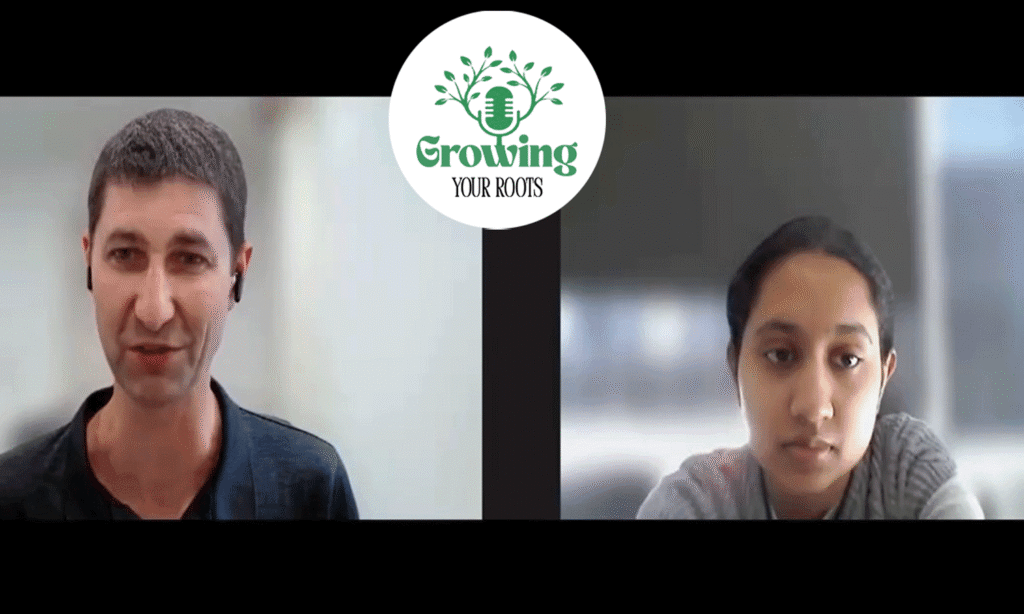
From volunteering in Honduras as a teenager to supporting agricultural development around the world, Mr. Austen Moore shares how unexpected experiences helped him discover his purpose and why finding yours is a journey, not a deadline.
What if discovering your purpose isn’t about knowing exactly what you want to do, but about being willing to explore what you don’t yet understand?
For many young people, the question “What do you want to do with your life?” can feel overwhelming. We are often encouraged to identify our passions, choose a career, and develop a clear plan for the future before we’ve had the opportunity to experience much of the world.
But what if our purpose isn’t something we discover all at once?
What if it emerges gradually through the people we meet, the challenges we encounter, and the experiences that change how we see the world?
In this episode of Rooted Voices, I had the opportunity to speak with Mr. Austen Moore, a senior technical advisor for agriculture and livelihoods at Catholic Relief Services, an international nonprofit organization.
Through his work, Mr. Moore supports programs addressing hunger, strengthening livelihoods, and helping families and communities build resilience in the face of hardship.
Yet his journey into international development was anything but straightforward.
From volunteering at soup kitchens as a child to living with a family in rural Honduras, serving in the Peace Corps in Timor-Leste, and eventually pursuing advanced degrees in agriculture, his experiences reveal an important lesson: Purpose is often discovered through action, rather than certainty.
The First Seeds of Purpose: Learning Through Service
Mr. Moore’s interest in helping others began long before he entered the professional world.
As a child, he regularly volunteered alongside his family, including at soup kitchens and organizations serving people experiencing homelessness.
These early experiences exposed him to an important reality: circumstances beyond an individual’s control can profoundly influence their opportunities and well-being.
He began recognizing how poverty, access to resources, and unexpected hardships could shape people’s lives.
Rather than viewing these challenges as distant problems, he became interested in how meaningful support could improve people’s circumstances.
At the same time, he developed a fascination with travel and different cultures.
These two interests, service and cultural exploration, would eventually intersect in ways that transformed his understanding of the world.
A Summer in Honduras That Changed Everything
During high school, Mr. Moore joined Amigos de las Américas, a volunteer program that places young people in rural Latin American communities.
He traveled to Honduras, where he and another volunteer lived with a local family.
For Mr. Moore, the experience offered something far more powerful than simply learning about poverty in a classroom.
He experienced aspects of everyday life in a community where basic necessities required significant time and effort.
Tasks such as collecting water and gathering firewood could consume hours of the day, leaving families with fewer opportunities to pursue education or other activities.
What particularly struck him was how something seemingly small could transform a family’s daily life.
For example, installing a water supply in a home could eliminate the need for children to spend hours collecting water.
That time could instead be used to attend school, study, or pursue other opportunities.
The experience taught him that seemingly modest improvements could have far-reaching consequences.
It also challenged the way he understood development and opportunity.
As we discussed during the interview, there is a difference between hearing about someone else’s circumstances and experiencing aspects of those circumstances firsthand.
Mr. Moore’s time in Honduras helped him appreciate the daily challenges faced by families living in poverty while revealing the potential for practical interventions to make a meaningful difference.
From the Peace Corps to Agriculture: An Unexpected Career Path
After graduating from university with a degree in history and anthropology, Mr. Moore was uncertain about his next step.
Rather than immediately pursuing a conventional career path, he joined the Peace Corps.
He was assigned to Timor-Leste, also known as East Timor, where he worked as a health volunteer in a country recovering from conflict.
During his service, he began recognizing a fundamental challenge facing many of the communities he encountered: food insecurity.
People struggling to find enough food for the present day often had limited capacity to plan for the future.
This realization changed the direction of his career.
Although his academic background was in history and anthropology, he began viewing agriculture as a powerful means of improving people’s lives.
Agriculture could address immediate nutritional needs while also supporting livelihoods and longer-term stability.
But making that transition required him to start over academically.
He returned to graduate school, earned a master’s degree in New Mexico, and later completed a PhD at the University of Florida.
After spending time in academia, he joined Catholic Relief Services, where he could apply his expertise to international development initiatives on a much larger scale.
His journey was not defined by a single career plan established at eighteen.
Instead, each experience introduced him to new challenges, questions, and opportunities.
His purpose became clearer as he continued learning.
Finding Purpose in Everyday Work
When I asked Mr. Moore how he actively lives out his purpose today, he explained that his work allows him to connect his professional responsibilities with his personal values.
As a technical advisor, he helps design and support development programs implemented by teams working with communities around the world.
These initiatives include improving agricultural practices, supporting food security, expanding access to clean water, and helping communities address health challenges.
Although his current responsibilities involve more planning and technical support than direct fieldwork, he still finds satisfaction in hearing how these programs improve people’s lives.
His role has changed over time, but the underlying purpose remains the same.
He continues working toward the goal that first motivated him as a young volunteer: helping people overcome barriers that limit their well-being and opportunities.
Our conversation also explored how purpose extends beyond a job title.
Mr. Moore described volunteering with community nonprofits, serving on nonprofit boards, mentoring international graduate students, and supporting members of his extended family in Timor-Leste.
For him, living with purpose means finding ways to contribute through both professional and personal relationships.
It isn’t confined to a particular career or organization.
Instead, it becomes a principle that influences how we choose to spend our time and support others.
Creating Change by Empowering Others
One of the most interesting ideas Mr. Moore shared was that meaningful impact does not always require directly helping every person affected by a problem.
Sometimes, supporting one individual can create opportunities for many others.
He described mentoring international graduate students, helping them with academic writing, dissertations, and career decisions.
Some of these students may eventually return to their home countries and become educators, researchers, or community leaders.
By helping one student overcome a challenge, Mr. Moore may indirectly contribute to the lives of countless people that student will later teach or support.
He explained that even a small contribution can be meaningful:
“If I can remove one barrier or give one good piece of advice to somebody that they can then take it further…”
That perspective stayed with me.
We often measure impact through visible results: how many people we personally help, how many projects we complete, or how much change we can immediately observe.
But Mr. Moore’s approach suggests that impact can also be multiplied through relationships.
A piece of advice, a mentorship opportunity, or a moment of encouragement may influence someone whose future contributions extend far beyond our own.
And sometimes, we may never see the full consequences of the help we provide.
That doesn’t make the contribution any less meaningful.
Why Finding Your Purpose Takes Time
Toward the end of our conversation, I asked Mr. Moore what advice he would offer young people who are still searching for their purpose.
His answer challenged the pressure many students feel to have their futures figured out.
Although his career journey might sound like a carefully constructed path when described in retrospect, he emphasized that it wasn’t always clear where he was headed.
He had to explore different interests, take risks, and reconsider his assumptions.
He encouraged young people not to rush into choosing a career or defining a permanent purpose before gaining enough experience to understand themselves.
Instead, he suggested allowing those ideas to evolve over time.
This was especially meaningful to me because students are frequently asked to make major decisions about their futures while still discovering their interests.
Choosing a college major, identifying career goals, and planning for adulthood can sometimes make uncertainty feel like a disadvantage.
But Mr. Moore’s story offers a different perspective.
Not knowing exactly where you’re going doesn’t mean you’re standing still.
Exploration itself can be an important part of discovering what matters to you.
The Importance of Stepping Outside Your Comfort Zone
Mr. Moore also emphasized the importance of challenging ourselves through unfamiliar experiences.
Looking back on his time in Honduras, he acknowledged that he could have spent a comfortable summer at home.
Instead, he chose an experience that required him to adapt to a different environment and way of life.
He took a similar approach when joining the Peace Corps, requesting a particularly challenging assignment.
For him, stepping outside his comfort zone created opportunities to understand the world and himself more deeply.
However, he emphasized that exploration does not always require international travel.
Young people can challenge themselves by joining unfamiliar clubs, meeting people from different backgrounds, or engaging with perspectives they might not ordinarily encounter.
Travel can be transformative, but so can meaningful conversations and new experiences closer to home.
The important part is remaining open to the possibility that our existing worldview is incomplete.
Sometimes, discovering what matters to us begins with encountering something we had never previously considered.
Turning Inspiration Into a Personal Purpose
Beyond exploring new experiences, Mr. Moore recommended taking time to reflect intentionally on the qualities and people we admire.
He shared how the career-development book What Color Is Your Parachute? helped him articulate his own purpose.
One exercise encouraged him to identify individuals he admired and consider the characteristics they shared.
For Mr. Moore, these qualities included humility, accomplishment, generosity, intelligence, and a commitment to serving others.
By identifying the characteristics he valued most, he was able to develop a clearer understanding of the kind of person he wanted to become and the contributions he hoped to make.
He explained that he had completed this exercise approximately ten years before our conversation.
When he revisited his reflections shortly before the interview, he found that they still accurately represented what mattered to him.
His experience illustrates how reflecting on our role models can reveal our own priorities.
Rather than beginning with the question “What job should I have?”, we might begin by asking:
What qualities do I admire in others, and how can I embody those qualities in my own life?
Our answers may provide clues about the purpose we hope to pursue.
Your Purpose Is a Journey, Not a Deadline
Perhaps the most reassuring part of our conversation was Mr. Moore’s reminder that finding purpose requires patience.
Our interests, priorities, and perspectives can change as we grow.
The person we imagine becoming today may be different from the person we hope to become five years from now.
And that’s okay.
Mr. Moore encouraged young people to challenge themselves, seek meaningful experiences, reflect on what they value, and remain open to change.
He also offered a simple reminder:
“Be kind to yourself. You know, this stuff takes time.”
His advice reframed purpose as something that develops through experience rather than a final answer we must discover by a certain age.
Throughout our conversation, I was struck by how seemingly unrelated moments in his life gradually came together.
Volunteering as a child introduced him to the importance of service.
Living in Honduras helped him understand how everyday challenges can limit opportunity.
His Peace Corps experience revealed the importance of food security.
His academic journey gave him the knowledge to address those challenges.
And his current work allows him to support communities and mentor others who may carry that impact forward.
Each experience built upon the last.
What initially appeared to be a series of individual decisions became a larger story about compassion, curiosity, and purposeful action.
Through Mr. Moore’s journey, I was reminded that our roots are not only the people and experiences that shaped our past.
They also influence the questions we ask, the risks we take, and the futures we choose to pursue.
Perhaps finding our purpose is less about discovering a destination and more about recognizing what continues to move us forward.
And sometimes, the most meaningful discoveries begin when we are willing to venture beyond the familiar.
This article is based on a Rooted Voices interview with Mr. Austen Moore, exploring purpose, international service, agriculture, mentorship, and the importance of embracing new experiences.
🎥 Watch the interview: https://www.youtube.com/watch?v=sCvdrGxrS-I