
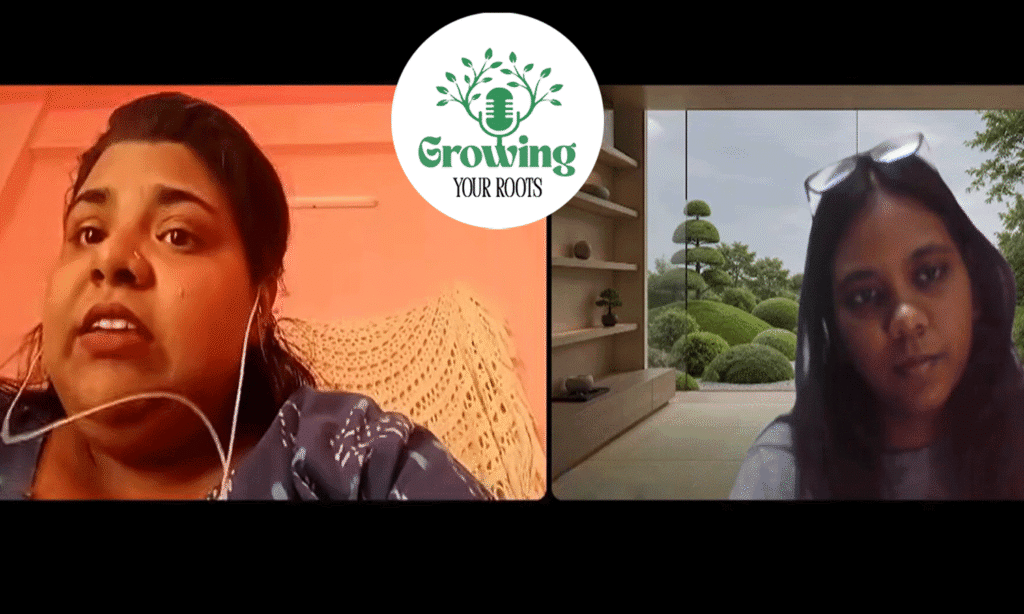
From navigating life’s unexpected transitions to learning the importance of acceptance and gratitude, Shrea shares why change is not simply something we experience, but something that helps us grow.
What if the one thing we could always count on in life was change?
We often search for stability in our relationships, careers, routines, and plans for the future. We find comfort in knowing what tomorrow might look like, who will be beside us, and where our decisions will lead.
But life rarely follows a perfectly predictable path.
Relationships evolve. Priorities shift. Opportunities emerge and disappear. Sometimes, we make the decision to begin a new chapter. Other times, circumstances make that decision for us.
In this episode of Growing Your Roots, we spoke with Shrea, a quality analyst at EXL, about navigating life’s transitions and learning to accept the things we cannot control.
Throughout our conversation, Shrea shared a thoughtful perspective on personal growth, resilience, and gratitude.
Her central message was simple but powerful: Change does not necessarily mean losing who we are. Sometimes, it means discovering who we are becoming.
The Only Constant in Life Is Change
When asked about significant transitions in her life, Shrea began by reflecting on the nature of change itself.
We often describe change as an interruption to our normal lives, something that happens when a relationship ends, a new opportunity appears, or an unexpected challenge forces us to reconsider our plans.
But Shrea encouraged us to think about change differently.
Rather than viewing it as an occasional disruption, she described it as a constant part of being human.
Our perspectives, priorities, goals, and relationships are continually evolving.
The person we are today is not exactly the person we were five years ago, and we are unlikely to remain the same five years from now.
Shrea explained that this transformation is not inherently positive or negative.
It is simply part of life.
As we move through different stages of childhood, adolescence, and adulthood, our experiences shape how we understand ourselves and the world.
Sometimes, we grow because we actively choose to change.
Other times, we grow because circumstances leave us with little choice.
Either way, growth requires us to adapt.
Her perspective challenged the idea that change must always be evaluated as a success or a failure.
Perhaps some transitions are better understood as opportunities to become more aware of ourselves and the lives we want to lead.
Learning to Accept What We Cannot Control
One of the most meaningful themes in our conversation was acceptance.
Shrea explained that one of the greatest challenges of change is learning to accept situations that fall outside our control.
When something unexpected happens, our first instinct may be to resist it.
We question why circumstances have changed, wonder whether we could have prevented them, or struggle to imagine a future different from the one we expected.
These reactions are understandable.
But Shrea suggested that personal growth begins when we recognize the limits of our control.
We cannot always determine what happens to us.
We can, however, reflect on how we respond.
Acceptance does not necessarily mean approving of every situation or pretending that difficult experiences are painless.
Instead, it can mean acknowledging reality without allowing our resistance to prevent us from moving forward.
For Shrea, this willingness to accept change is closely connected to resilience.
As we learn to navigate uncertainty, we develop new perspectives and discover strengths we may not have recognized before.
Life Is a Book, and Change Is Turning the Page
During our conversation, we explored another difficult aspect of change: leaving things behind.
When we enter a new chapter of life, we may have to move away from familiar places, reconsider relationships, or let go of plans that once felt important.
I asked Shrea how we can learn to accept these transitions, especially when moving forward seems to require losing something meaningful.
Her response offered a different way of understanding the experience.
She questioned whether moving forward should always be described as losing.
Instead, she compared life to a book.
“Your life is a book and you are just turning over the page.”
In her view, the experiences, people, and memories from earlier chapters do not simply disappear when our circumstances change.
They remain part of our story.
Even when a relationship ends or a familiar environment changes, the experiences we gained can continue shaping our understanding of ourselves.
Turning a page does not erase the pages that came before it.
It allows the story to continue.
This metaphor was particularly meaningful because it reframed change as a process of continuation rather than complete separation.
We do not necessarily have to abandon our past to embrace our future.
We can carry its lessons with us.
Letting Go Without Losing Yourself
Shrea also reflected on the emotional difficulty of recognizing when something no longer fits our lives.
Sometimes, we remain attached to a relationship, place, or expectation because it once brought us comfort.
We may wonder whether moving on means we have failed or whether the change is somehow our fault.
But Shrea encouraged a more compassionate perspective.
Not every relationship, environment, or opportunity will remain aligned with who we are becoming.
And recognizing that mismatch does not necessarily mean that someone has done something wrong.
Sometimes, circumstances simply change.
Shrea emphasized the importance of trying to understand a situation before deciding to move forward.
Once we recognize that something is no longer right for us, we can begin accepting that reality rather than endlessly questioning it.
Her advice was to approach these moments with gratitude, acknowledge what the experience contributed to our lives, and continue toward something better suited to our needs.
What stood out to me was her emphasis on maintaining a sense of self throughout the process.
Change can require us to reconsider our circumstances, but it does not have to mean abandoning our values or identity.
Instead, we can learn to distinguish between the experiences that shaped us and the situations we no longer need to remain in.
Why Growth Sometimes Happens Before We’re Ready
Another interesting idea Shrea shared was that growth is not always voluntary.
We often associate personal development with intentional decisions: setting goals, learning new skills, or choosing to step outside our comfort zones.
But some of the most significant changes in our lives occur unexpectedly.
A friendship may change.
A career opportunity may require us to move.
A personal challenge may force us to reconsider priorities we once took for granted.
In these moments, we may not feel prepared for the transition.
Yet the experience can still influence how we think, act, and understand ourselves.
Shrea described change as something connected to evolution, resilience, acceptance, and letting go.
Her perspective suggests that growth does not always begin with confidence.
Sometimes, it begins with uncertainty.
And although we may not immediately understand the significance of a particular experience, we can gradually discover what it has taught us.
Finding Gratitude in Life’s Transitions
Toward the end of our conversation, I asked Shrea what advice she would offer future generations about navigating change.
Her response shifted our discussion from accepting what changes to appreciating what remains.
She reflected on the relationships and experiences that had changed throughout her own life.
Rather than focusing exclusively on what was no longer present, she emphasized the importance of recognizing what we still have.
She summarized this perspective with a memorable thought:
“A beautiful life isn’t … having everything, but to appreciate what remains with you.”
Her words challenge a common assumption about happiness.
We often imagine that life will become fulfilling once we achieve a particular goal, acquire something we want, or reach a certain stage.
But even when we accomplish those things, we may continue searching for something more.
Shrea encouraged us to appreciate the relationships, opportunities, and experiences already present in our lives.
This does not mean we should stop pursuing our ambitions.
Rather, it suggests that our ability to appreciate the present should not depend entirely on achieving everything we hope for in the future.
Gratitude allows us to recognize the value of what we have, even when our circumstances are imperfect.
Appreciating What Remains
One of the most powerful aspects of Shrea’s perspective was the connection she drew between acceptance and gratitude.
When life changes unexpectedly, it can be easy to focus on what is missing.
We may compare our current circumstances to the past or imagine how different things might have been.
But Shrea encouraged us to redirect some of that attention toward what remains meaningful.
The relationships that continue to support us.
The lessons we have learned.
The opportunities we still possess.
And the simple experience of being alive and able to continue growing.
She reminded us that having everything is not the same as appreciating what we have.
Her message was not about denying disappointment or pretending that loss is insignificant.
It was about recognizing that even when one part of our lives changes, other sources of meaning can remain.
Change Is Not the End of Your Story
As our conversation came to a close, I found myself returning to Shrea’s metaphor of life as a book.
Every chapter contains different people, experiences, challenges, and discoveries.
Some chapters may be filled with excitement and possibility.
Others may involve uncertainty, disappointment, or difficult transitions.
But each becomes part of the larger story.
Shrea’s perspective reminded us that we are continually evolving.
The person we were in the past does not have to determine every decision we make in the future.
At the same time, we do not need to erase our past in order to grow.
We can honor what we have experienced while remaining open to what comes next.
Perhaps embracing change is not about learning to leave everything behind. It is about learning what to carry forward.
Through Shrea’s reflections, we are reminded that our roots are not fixed in a single moment.
They grow and develop alongside us, shaped by the relationships we form, the challenges we navigate, and the lessons we choose to remember.
Change may alter the direction of our lives, but it also creates opportunities for new perspectives, connections, and possibilities.
And as we turn each new page, we can carry something valuable from the chapters that came before.
This article is based on a Growing Your Roots interview with Shrea, exploring change, acceptance, resilience, gratitude, and the importance of appreciating what remains.
🎥 Watch the interview: https://www.youtube.com/watch?v=Two4KTfw8xE